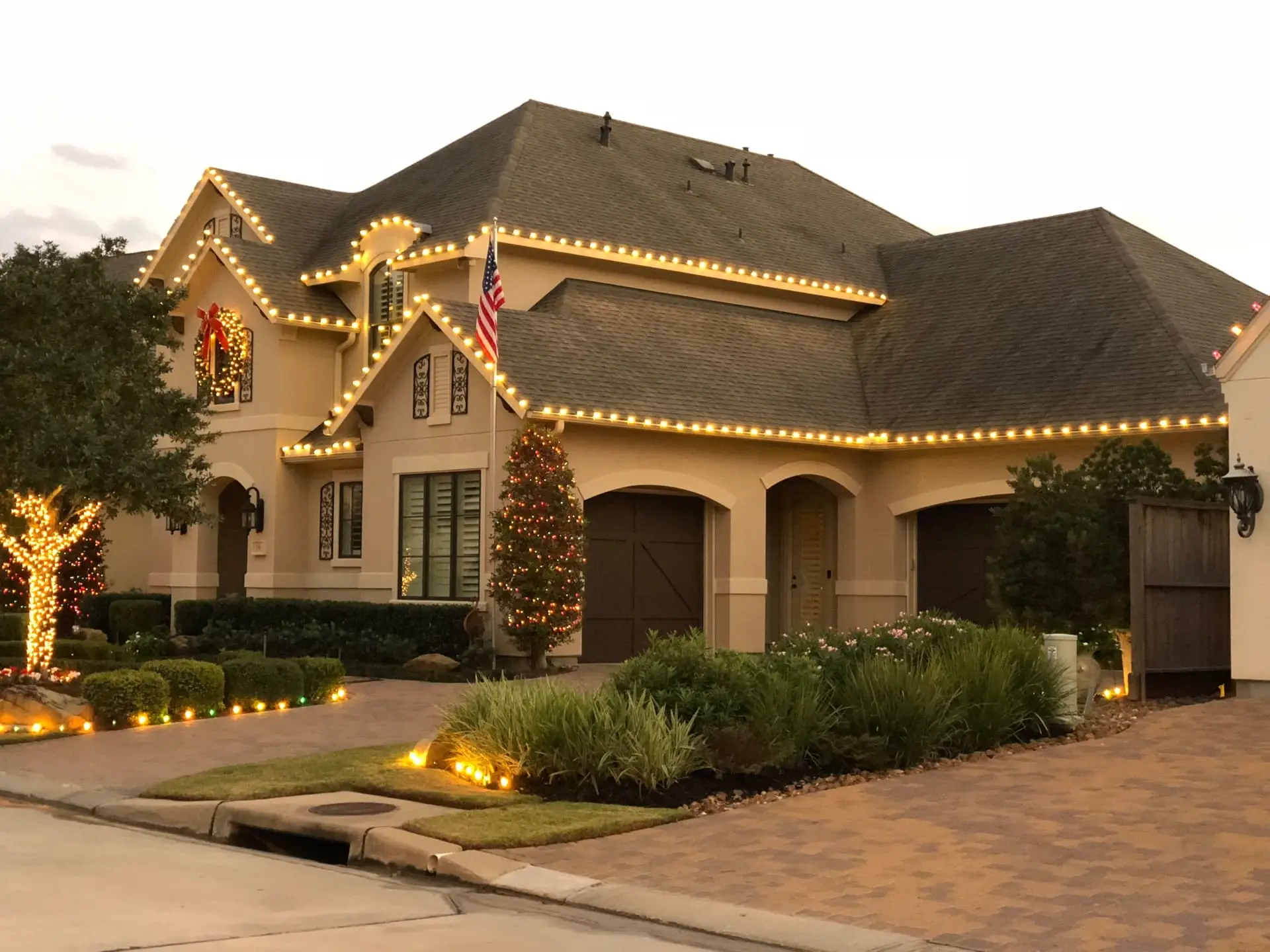
Wide two-story homes with mature trees and lots of architectural detail are some of the most rewarding holiday lighting projects we do. There's more to light, more to frame, and more interplay between the building and the trees than a simpler facade gives you. A property like this one takes a 3 to 4 person crew a full day every November to put up. By the time we're done, the building and the trees read as one composition rather than a house with some lights on it.
The family has been with us for ten seasons. They originally came to us at a smaller home and the relationship carried over when they moved here. The display has evolved substantially since then. Both in scope and in the way we approach individual elements. And every year we add more layers or refine what's already there.
Years with this family
Front yard trees
Full install day
2025 season cost
Most recent install
West Houston, near River Oaks
Ten seasons of evolving one display.
For the first several seasons we wrapped the four live oaks in the front yard. Trunk and canopy, running up as high as we could get. That much wire and that many bulbs on a single run started causing overloads. We were managing multiple timers just to spread the load, and animals chewing into the wires became a recurring issue that triggered callbacks throughout the season.
We switched to hanging light bursts. Sometimes called sparklers. From the trees rather than wrapping them. The visual is actually better: a more intentional starburst look rather than a fully wrapped tree. We added matching ground-level light bursts at the base of each tree to complete the composition. No overloads, no multi-timer management, and far fewer callbacks from animal damage.
The first half of this relationship ran on incandescent C7 bulbs. About five seasons back we upgraded the entire display to C9 LED. Classic white. Energy draw dropped substantially, the bulbs run cooler and last longer, and the color is more consistent across the whole display. Since the conversion, the system has been steady. Routine bulb, clip, and stake replacements each year as part of the reinstall.
Front: light bursts hanging from all four live oaks with matching ground bursts below them, roofline along the entire front facade, roofline on the right side along the driveway and over the garage, arch lighting outlining the front door, garland around the entry, swags on either side of the door, approximately 10 customer-provided reeds installed on the house, bed lining with C9 stakes along all the landscaping beds, and the client's own collection of Christmas décor pulled from storage, connected, and powered. Back: tall trees wrapped up to about 20 feet, and lighting on the backyard fireplace.
Every reinstall includes re-conditioning the full system. Clips, stakes, bulbs that failed during storage or wore out over the previous season all get replaced as part of the service, not billed separately. We don't nickel-and-dime the small stuff. The display goes back up exactly as it was the year before unless the family requests changes, in which case we scope and quote the changes on their own.
$5,400.
2025 reinstallation. Full-season service, start to finish.
A holiday display at this scale is many small jobs working together. Each piece in the list to the left has its own clip system, its own circuit considerations, its own timing in the install day. The reason it takes a 3 to 4 person crew a full day is that none of it gets rushed. The roofline alone could be the whole job at a smaller home.
First-year installations are priced substantially higher than this. The first year covers all of the materials, custom-cut and sized to the property, plus install, maintenance, takedown, and storage. After that, returning customers come in at roughly 20–25% less each year for the reinstallation, since the materials are already cut for the home and live with us between seasons. If the design doesn't change, the reinstall price doesn't change either.
Every reinstall includes re-conditioning the system. Failed bulbs, broken clips, snapped stakes all get replaced as part of the service, not invoiced separately. Design changes are priced on their own. Because the materials belong to the family, any change involves purchasing the new materials plus labor to swap them in. Removing elements brings the cost down. Adding elements brings it up. Even same-footprint changes like swapping bulb colors cost extra, since new materials are involved either way.
Installs Oct–Dec. On-call through Christmas. Down by end of January.
We run holiday installs from October 1 through mid-December, booking each family into a specific window. This family always requests a premium November slot. A week or two before Thanksgiving. So the display is up well before the holiday rush. Books fill up by early fall.
Fresh-element greenery. Wreaths, garland, swags. Goes up on a dedicated November visit rather than being bundled into the main install day. That puts the greenery up closer to the start of the season so it holds its look all the way through the end of December.
Maintenance is reactive, not scheduled. If a breaker trips, a bulb fails, or a timer shifts, the family contacts us and we're typically on-site within 48 hours to address whatever the issue is. No extra service charge. It's included in the reinstall cost. We handle maintenance calls all the way through Christmas.
Starting January 2 we begin removing all lights and décor. Takedown dates aren't scheduled individually, but everything comes down before the end of January. Materials are coiled, labeled, and stored in our facility until the following year. The client doesn't have to think about where anything is or whether it survived in the attic. When we show up next season, everything is staged and ready.
Related to this project.
The Christmas lighting service this install came from, and a guide on what a full-season holiday install costs.
Ready for this season?
We book up by October. The earlier you're on the schedule, the more install date options you have.